%20(1).jpg)
Remember when "optimizing operations" meant endless spreadsheets and reactive problem-solving? Those days are over.
With AI-powered operational optimization, systems can predict your inventory needs, offer 24/7 customer support, and even prevent equipment failures before they happen.
This isn't just a minor upgrade; it's a fundamental shift in how we work, allowing us to streamline processes, cut costs, and maximize output like never before.
Key areas for improving operational efficiency with AI technologies
From the factory floor to the front office, AI is making operations smarter and more responsive. Let's look at some of the most impactful areas where it's driving real change.
1. Automating repetitive processes
This is often the first and most visible benefit of AI. Automations free up your team to focus on work that requires human creativity and strategic thinking, especially in project management, where reducing manual admin creates room for higher-value decision-making.
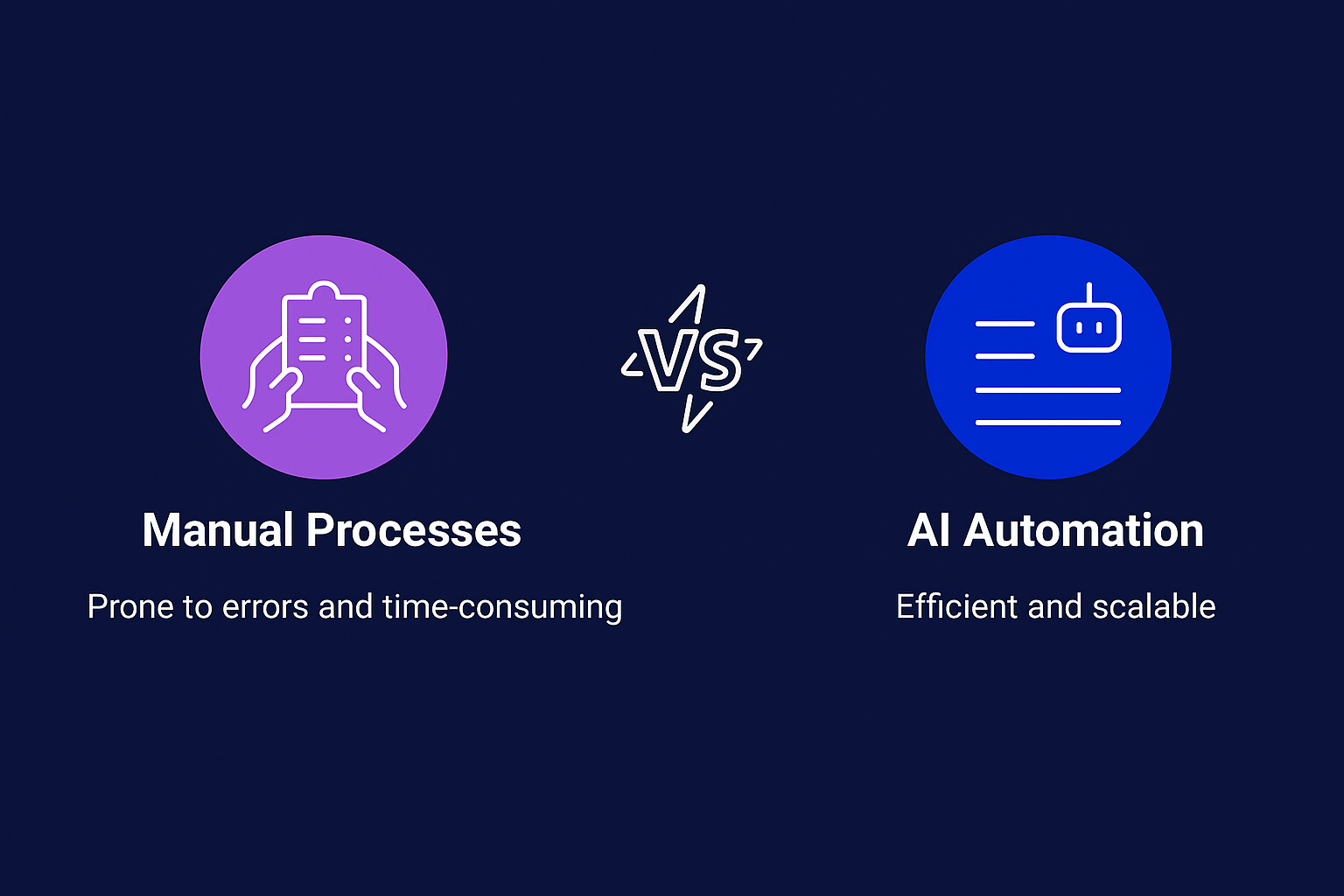
The payoff is substantial:
- Drastically cut down processing times
- Minimize errors that come from manual work
- Run operations 24/7 without skipping a beat
- Easily scale up or down to handle demand spikes
2. Predicting maintenance needs
In industries that rely on heavy machinery, predicting a breakdown before it happens is a game-changer. AI analyzes sensor data and maintenance history to flag issues early, allowing you to fix them on your schedule.
The benefits here are clear:
- Less unexpected downtime
- Lower repair and maintenance costs
- Longer-lasting equipment
- Smarter, more efficient maintenance schedules
3. Optimizing supply chains
AI brings a new level of intelligence to supply chain management. It provides deeper insights, sharpens forecasting, and enables adjustments across the entire network.
This leads to:
- Much more accurate demand forecasts
- Optimized inventory that reduces excess stock
- Better supplier selection and management
- Route optimization for logistics
4. Enhancing quality control
With computer vision, AI is revolutionizing quality control. It can spot microscopic defects with an accuracy and consistency that is hard for the human eye to match.
This means:
- Higher accuracy in detecting flaws
- Consistent quality standards, every time
- Real-time monitoring and instant alerts
- Less waste and fewer do-overs
5. Managing energy consumption
For energy-intensive businesses, AI is a powerful tool for optimization. It intelligently manages consumption, leading to significant cost savings and a smaller environmental footprint.
The key advantages are:
- Direct reduction in energy costs
- A lower carbon footprint
- Smarter energy distribution
- Predictive maintenance for energy systems
6. Revolutionizing customer service
For marketing companies and customer-facing businesses, AI operations improvement starts with service. AI-powered agents provide instant, around-the-clock support, handling common questions while freeing human agents to tackle more complex issues.

This transformation delivers:
- Reduced customer response times
- Lower operational costs for support teams
- Improved customer satisfaction with instant help
- Support that easily scales during busy periods
Types of AI technologies that drive operational efficiency
AI isn't a single tool; it's a versatile toolkit. Each technology offers a unique way to streamline operations, cut costs, and boost productivity.
Here are four key players making a difference today:
Challenges and considerations when implementing AI
For tech companies and software businesses, operational efficiency for AI technologies requires more than just buying tools. It also demands strategic implementation.
1. Data quality and availability: The foundation of AI success
An AI system is only as good as the data it learns from. Without accurate, clean, and comprehensive data, even the most advanced AI will struggle to deliver useful results.
The challenge: Many companies have data that's fragmented, outdated, or sitting in separate silos. Inconsistent formats or gaps in information can lead to flawed and ineffective AI models.
How to address it: This requires an investment in data management. Businesses need to build a solid data infrastructure, clean up existing information, and ensure consistent collection practices. Sometimes, supplementing internal data with external sources is necessary.
2. Integration with existing systems: Ensuring seamless operations
For AI to be effective, it needs to work smoothly with the software and systems you already use, like your ERP or CRM.
The challenge: Legacy systems often aren't built to work with modern AI, leading to complex compatibility issues. Data silos can also prevent the AI from getting a complete picture of your operations.
How to address it: Start with a thorough audit of your current IT landscape. You may need to upgrade outdated infrastructure or use API integrations to connect old and new systems. Consolidating data sources is also crucial.
3. Employee training and change management: Building a future-ready workforce
Introducing AI changes how people work. Proactive training and clear communication are critical to helping your team adapt and thrive alongside new technology.
The challenge: It's natural for employees to feel uneasy about AI, fearing their jobs might change or become obsolete. Without proper training, they may not know how to use the new tools effectively.
How to address it: Create comprehensive training programs that build skills in data literacy and using AI visualization tools. Foster open communication to address concerns and show how AI will augment their roles, not replace them.
4. Ethical considerations and bias mitigation: Ensuring fair and responsible AI use
Because AI learns from data, it can unintentionally perpetuate and even amplify existing human biases if not carefully managed.
The challenge: AI systems can discriminate based on gender, race, or other factors if the training data is biased. The "black box" nature of some AI can also make it hard to understand how a decision was made.
How to address it: Proactively audit data and algorithms for bias. Continuously monitor AI outputs for fairness. Building diverse development teams and establishing clear ethical guidelines for AI use are also critical steps.
The future of AI in business operational efficiency

The AI revolution is just getting started. As we look ahead, several emerging technologies promise to redefine what's possible in business operations.
1. Edge AI: Intelligence at the source
Instead of sending data to the cloud, Edge AI processes it right on the device where it's generated, like a sensor or a camera. This means faster decisions and less delay.
Potential impacts:
- Manufacturing: Instant defect detection on a production line.
- Healthcare: A wearable device that can respond to a health emergency in real-time.
- Retail: Smart shelves that update inventory and pricing automatically.
2. Explainable AI (XAI): Opening the black box
This technology focuses on making AI's decision-making process transparent and understandable to humans. It's crucial for building trust, especially in high-stakes fields.
Potential impacts:
- Finance: Providing clear reasons for why a loan was approved or denied.
- Healthcare: Offering understandable explanations for an AI-assisted diagnosis.
- Human Resources: Giving transparent reasoning behind AI-driven hiring recommendations.
3. AI-powered digital twins: A virtual revolution
A digital twin is a virtual replica of a physical asset, process, or system. It uses data and AI to simulate, predict, and optimize performance without any real-world risk.
Potential impacts:
- Supply Chain: Modeling and optimizing global logistics networks in real-time.
- Urban Planning: Testing new city infrastructure designs in a virtual environment.
- Energy: Optimizing the entire power grid for maximum efficiency and reliability.
4. Quantum AI: Supercharging problem-solving
By combining quantum computing with AI, this emerging field can solve complex problems that are currently impossible for classical computers, thanks to its incredible processing power.
Potential impacts:
- Drug Discovery: Simulating molecular interactions to accelerate the development of new medicines.
- Financial Modeling: Achieving ultra-precise risk assessment and fraud detection.
- Climate Modeling: Creating more accurate models to predict and combat climate change.
Achieve operational efficiency with AI-driven solutions
The potential of AI to transform your business’s operational efficiency is real, whether you're a marketing company, software business, or enterprise. As more organisations adopt AI for enterprise-level operational efficiency, the impact on productivity and decision-making becomes impossible to ignore.
Improvement involves optimizing your processes, reducing costs, and empowering your team to achieve more. These technologies provide the tools to simplify your operations in ways that were once unimaginable.
The future of efficient operation is intelligent, and the time to start that journey is now!
_light%201.avif)