%20(1).jpg)
Running a small business means time is always in short supply. Every admin task, follow-up, or manual process chips away at the work that really moves the needle. That is where AI for small businesses starts to matter, not as a buzzword, but as a practical advantage.
Today, many routine tasks can be handled quietly in the background. Invoices get sorted, customer questions get answered, and reports show up without hours of manual effort. The result is simple.
This article looks at how AI supports day-to-day operations, improves efficiency, and helps small teams compete without adding headcount.
How AI supports small businesses across key areas
AI is not one single tool or system. For small businesses, AI project management plays specific roles across daily operations, customer experience, and decision-making. The real value comes from how these roles reduce manual effort, improve consistency, and free up time for higher-impact work.
Below are the main ways AI shows up in practice, along with the benefits that come with each role.
AI for customer support and communication
One of the earliest and most visible roles of AI is customer support. Small teams often struggle to respond quickly while managing other priorities. AI helps fill that gap by handling common questions and routine interactions.
What this role looks like in practice
- Automated responses to FAQs and basic inquiries
- 24/7 availability without hiring extra staff
- Consistent tone and messaging across channels
Key benefits for small businesses
- Faster response times that improve customer satisfaction
- Fewer interruptions for your team during the day
- More time for human agents to handle complex issues
This is where many AI-powered business solutions for small enterprises start, because the impact is immediate and measurable.
AI for marketing and content creation
Marketing is essential, but it is also time-consuming. AI now supports small businesses by assisting with content creation, design, and campaign planning, without replacing human judgment.
What this role looks like in practice
- Drafting blog posts, emails, and ad copy
- Creating visual assets with minimal design effort
- Adapting content for different platforms and audiences
Key benefits for small businesses
- Faster content production with fewer bottlenecks
- More consistent brand output across channels
- Reduced reliance on external resources for basic marketing tasks
AI helps business teams stay visible and active, even with limited time and staff.
AI for project and task management
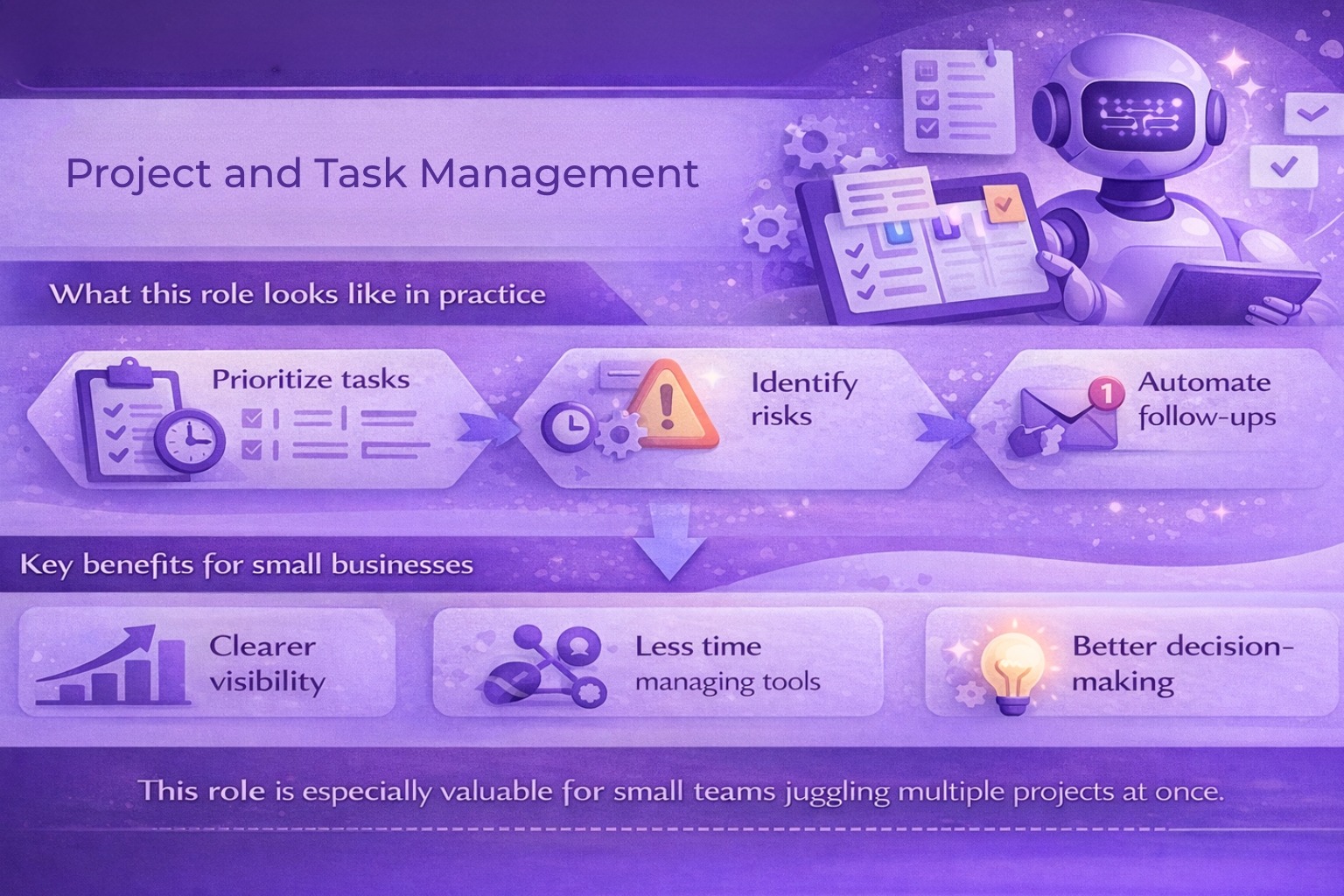
As businesses grow, coordination becomes harder. AI supports planning and execution by helping teams stay organized and focused on the right priorities.
What this role looks like in practice
- Prioritizing tasks based on deadlines and workload
- Identifying risks or delays early
- Automating routine follow-ups and updates
Key benefits for small businesses
- Clearer visibility into progress and responsibilities
- Less time spent managing tools instead of work
- Better decision-making with real-time insights
This role is especially valuable for small teams juggling multiple projects at once.
AI for sales and lead management
Sales processes often depend on timing and follow-through. AI helps small businesses manage leads more effectively and avoid missed opportunities.
What this role looks like in practice
- Scoring and prioritizing leads automatically
- Tracking conversations and follow-ups
- Forecasting sales activity based on data
Key benefits for small businesses
- Better focus on high-quality prospects
- More consistent follow-up without manual tracking
- Improved visibility into what drives conversions
These custom AI helps sales teams stay organized without adding complexity.
AI for workflow automation and productivity
Many small business processes involve repetitive steps across multiple tools. AI connects these systems and automates routine workflows.
What this role looks like in practice
- Moving data between apps automatically
- Triggering actions based on events
- Reducing manual data entry
Key benefits for small businesses
- Fewer errors caused by manual processes
- Hours saved each week on repetitive work
- Smoother operations across teams
This role is often less visible but delivers some of the biggest efficiency gains.
AI for finance, HR, and back office operations
Behind the scenes, AI supports HR areas that are essential but often overlooked, like accounting, payroll, and hiring.
What this role looks like in practice
- Categorizing expenses and tracking cash flow
- Screening candidates and scheduling interviews
- Managing compliance and employee data
Key benefits for small businesses
- Better financial visibility and control
- Faster, more consistent hiring processes
- Reduced administrative burden
These applications round out how AI tools support business growth without adding operational strain.
The evolving role of AI in small businesses
AI is becoming less about standalone tools and more about how systems work together behind the scenes. For small businesses, this shift means fewer disconnected platforms and more cohesive support across daily operations.
As AI continues to mature, usability and relevance will matter more than advanced features. Future solutions will focus on fitting naturally into existing workflows, offering clearer insights, and supporting better decisions without adding friction.
The most successful adopters will be those who treat AI as a long-term capability, not a short-term trend.
How to choose the right AI tool for your small business
Choosing AI is not about finding the most advanced tool on the market. It is about finding the right fit for how your business actually works today. The best results come from using AI for a small business to solve real problems, not from adopting technology for its own sake.
Before investing in any platform, it helps to step back and evaluate a few key areas.
Start with a clear business need
Every successful AI adoption starts with a simple question: what problem are we trying to reduce or remove?
AI can support many parts of a small business, but it works best when tied to a specific outcome rather than a broad goal.
Common areas where AI adds value
- Marketing and content creation, where speed and consistency matter
- Customer support, where response time affects satisfaction
- Sales and lead management, where follow-up and prioritization are critical
- Internal productivity, where repetitive tasks slow teams down
- Finance and admin, where accuracy and visibility are essential
When AI is chosen based on pain points, it is far more likely to deliver measurable value.
Set realistic budget expectations
AI pricing can vary widely, and costs are not always obvious at first glance. What looks affordable initially can grow as usage increases or features are added.
Typical pricing models you will encounter
- Free or limited plans designed for testing and basic use
- Subscription plans based on features or team size
- Usage-based pricing that scales with activity
How to approach budgeting
- Start small and test before committing long-term
- Compare cost against time saved or errors reduced
- Avoid stacking multiple tools that solve the same problem
The goal is not the cheapest option, but the one that delivers the strongest return.
Check how well it fits your existing setup
AI works best when it blends into your current workflow. Tools that require constant switching or manual work often create friction instead of efficiency.
Questions worth asking
- Does it integrate with the tools you already use
- Can it share data easily with your existing systems
- Will it simplify workflows or add extra steps
Strong options tend to feel invisible once set up. They support work instead of interrupting it.
Consider ease of use and adoption
Even powerful AI tools fail if teams struggle to use them. For small businesses, especially, simplicity matters.
What to look for
- Clear interfaces that do not require technical expertise
- Sensible defaults that work without heavy configuration
- Access to guides, onboarding, or support when needed
If a tool feels difficult to use in the first week, it rarely gets easier later.
Think long term, not just immediate wins
AI adoption should support where your business is heading, not just where it is now.
Long-term considerations
- Can the tool scale as your business grows
- Will it adapt as processes change
- Is the provider actively improving the product
The most effective custom solutions for small businesses grow alongside the teams using them, rather than needing to be replaced every year.
The risks and challenges of using AI in small businesses
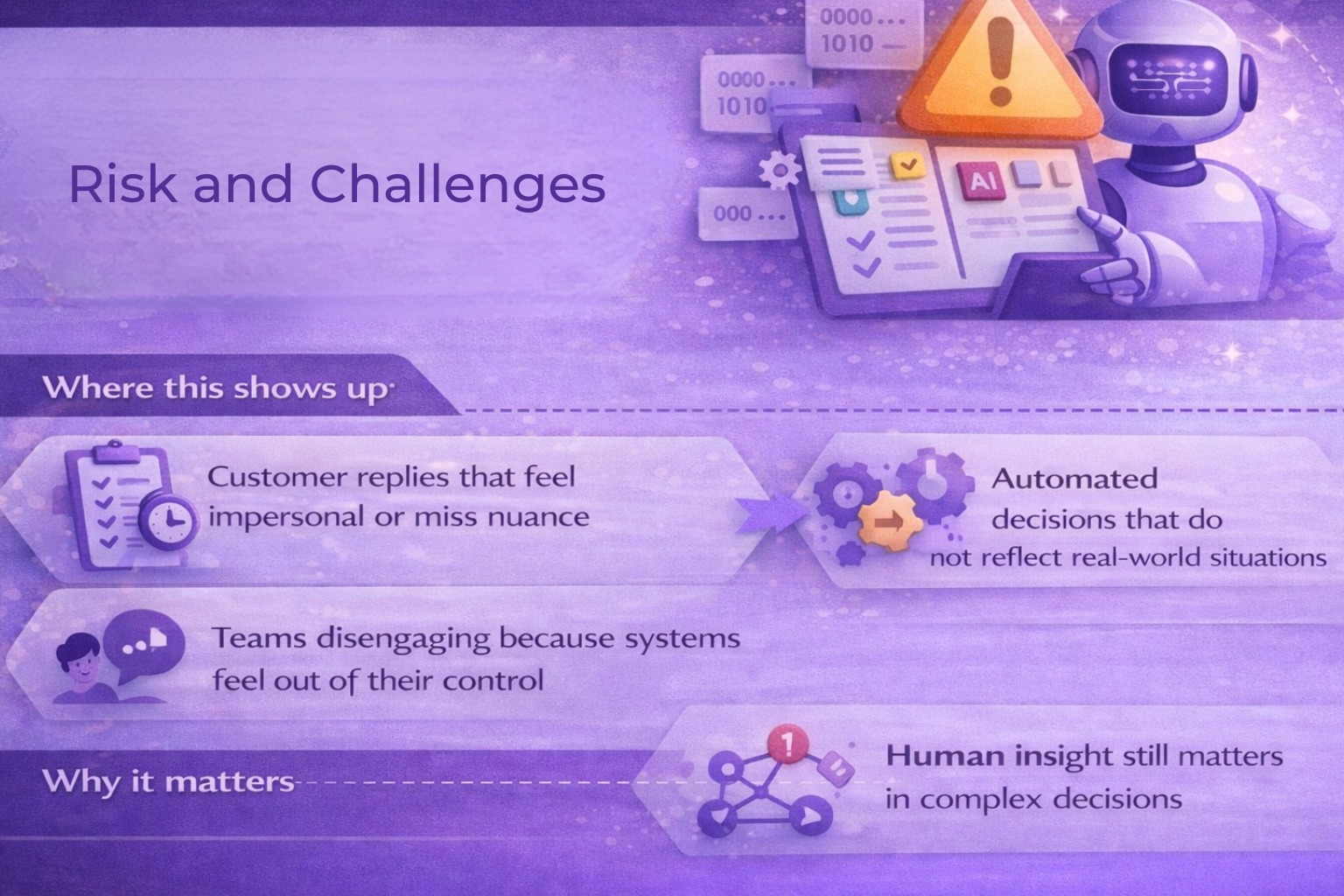
AI brings clear advantages, but it is not without trade-offs. For small businesses, the risks are less about the technology itself and more about how it is chosen, implemented, and managed. Understanding these challenges helps set realistic expectations and avoid costly mistakes.
Overreliance on automation
AI works best as support, not a replacement for human judgment. When too much is automated too quickly, important context can be lost.
Where this shows up
- Customer replies that feel impersonal or miss nuance
- Automated decisions that do not reflect real-world situations
- Teams are disengaging because systems feel out of their control
Why it matters
- Customer trust can suffer if interactions feel generic
- Small errors can scale fast when unchecked
- Human insight still matters in complex decisions
Building an AI-powered small business, one step at a time
AI is no longer just a competitive advantage. For many small businesses, it has become part of how everyday work gets done.
The most effective approach is gradual. Start with the areas that consume the most time or create friction, then introduce AI-related solutions that deliver clear, measurable improvements.
When chosen carefully, these tools can help small teams stay focused, work more efficiently, and grow without unnecessary complexity. The goal is not to use more AI, but to use it where it quietly makes the biggest difference.
_light%201.avif)