%20(1).jpg)
The everyday realities of telecom projects include laying fiber optic cables under oceans, managing thousands of cell towers across a single region, and making sure millions of people stay connected, 24/7.
Telecom project management operates on a scale most industries can't imagine. One miscalculation doesn't just delay a project. It can knock out service for entire cities.
That's why telecom PMs have mastered the art of orchestrating massive infrastructure upgrades without anyone noticing.
Inside the telecom PM playbook: How leading telecoms manage projects at scale
Telecom companies orchestrate mission-critical systems that power entire nations.
From rolling out next-gen networks to ensuring 99.999% uptime, their approach to telecoms project management is structured, scalable, and built for resilience, strengthened further by the use of advanced telecommunications project management software.
Here's how telecom leaders execute projects.
Methodological flexibility: The telecom advantage
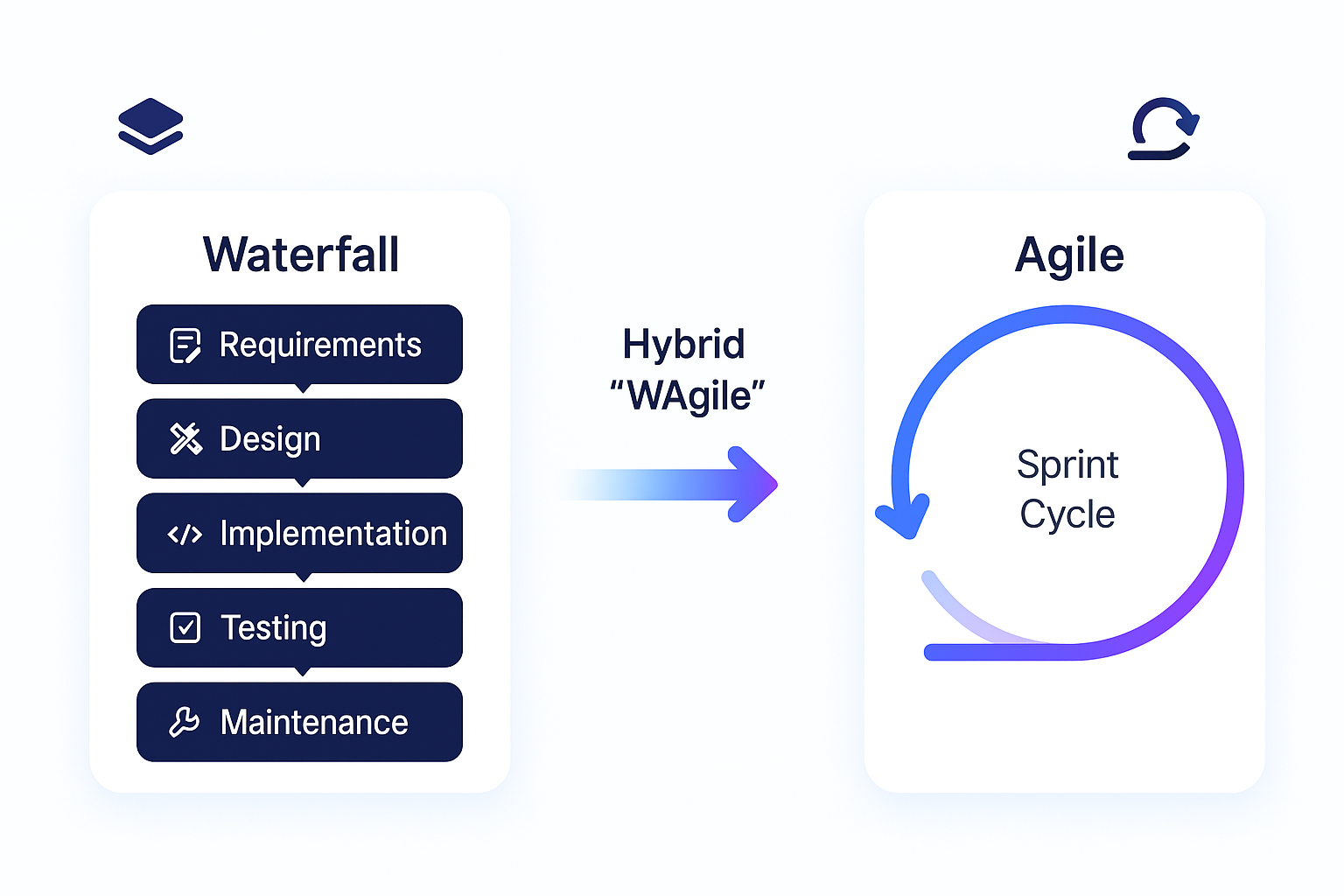
Telecommunications project management software rarely sticks to a single project management methodology. Instead, they mix and match approaches based on project needs, a flexible model that drives optimization.
- Waterfall still dominates infrastructure-heavy projects like tower construction or data center development. When you're dealing with compliance requirements and safety protocols, sequential progress and rigid documentation are essential.
- Agile has taken over for service development, software integration, and customer-facing systems. These projects need teams that can pivot quickly when market conditions shift or customer needs evolve.
- Hybrid frameworks represent the sweet spot for most telecom work. Industry insiders call it "WAgile" or "Structured Agile", combining waterfall's predictability with agile's flexibility. It's not about following trends; it's about matching methodology to reality.
The pattern is clear: network infrastructure projects get traditional milestone-based approaches, while customer applications thrive under agile sprints. The best telecom organizations let the project dictate the methodology, not the other way around.
Cross-functional integration: Breaking down technical silos
Telecom projects can't succeed in isolation. Unlike industries where project teams work independently, telecommunications demands unprecedented collaboration across domains that traditionally don't talk to each other.
Successful telecom companies handle project management with user roles and teams that bridge these gaps:
- Technical specialists, RF engineers, network architects, and security experts bring the deep knowledge required for infrastructure projects
- Business analysts keep everything aligned with market demands and revenue goals
- Regulatory experts navigate the maze of compliance requirements unique to telecommunications
- Customer experience professionals ensure technical decisions actually improve service quality
The secret sauce? Structured communication protocols that translate technical requirements into business objectives and vice versa. Many teams run daily stand-ups that pull in both technical and business representatives. It's the fastest way to catch disconnects before they derail the entire project.
Phased implementation: The telecom deployment lifecycle
Telecommunications projects follow a distinct rhythm that balances innovation with service continuity. The phased approach evolved specifically to minimize disruption while maximizing deployment efficiency.
Here's how the standard telecom project lifecycle breaks down:
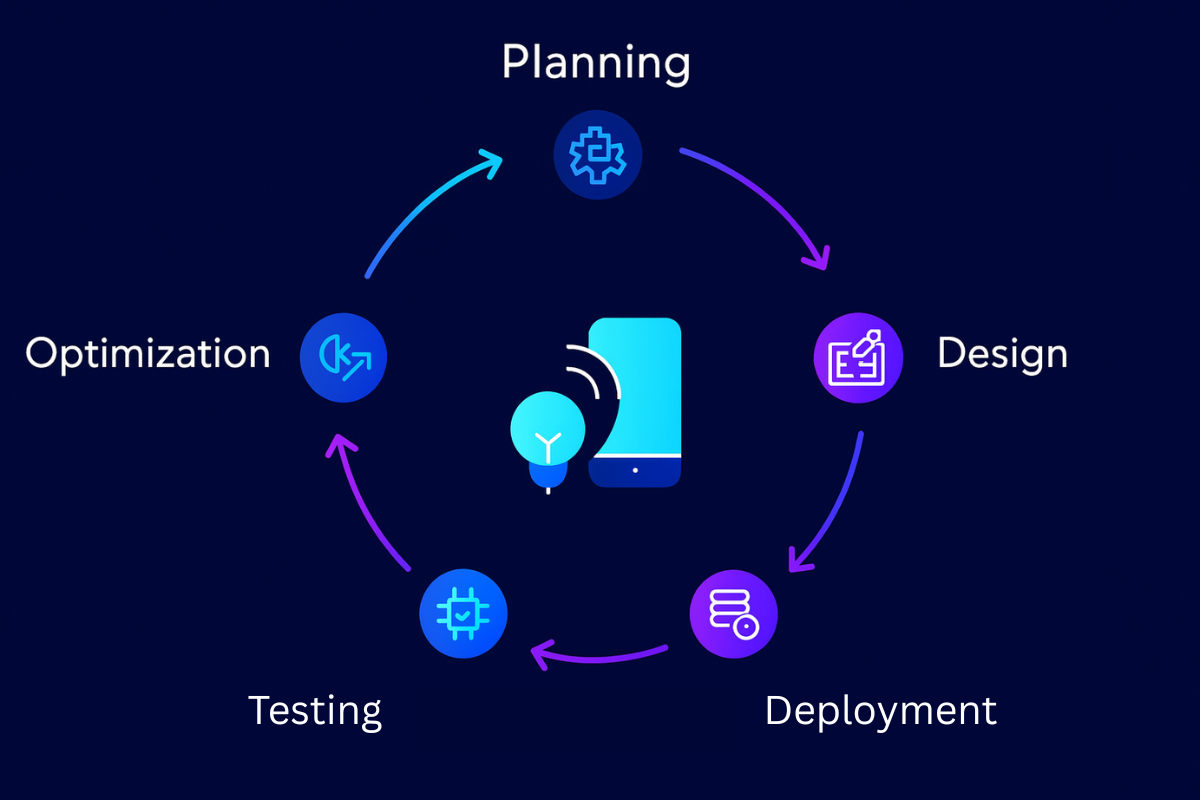
- Planning phase: Teams define scope, requirements, and success metrics, with special attention to network impact assessment. This isn't generic planning; it's about understanding exactly how changes will ripple through live systems.
- Design phase: Technical specifications and architectural documents get created with built-in redundancy considerations. If something fails, there's always a backup plan.
- Deployment phase: Technical solutions get implemented during carefully orchestrated rollout schedules, often in designated maintenance windows. Timing is everything when millions of people depend on uninterrupted service.
- Testing phase: Multi-level verification runs from unit testing to full system integration, with heavy emphasis on load testing and failure scenarios. Teams simulate worst-case conditions before customers ever experience them.
- Optimization phase: The work doesn't stop at launch. Teams refine implementation based on performance metrics and user feedback through continuous improvement cycles.
What sets project management in telecommunications apart is the obsession with service continuity throughout every phase.
Risk management: Protecting service continuity
Network outages can disrupt business operations and emergency services. That's why risk management in telecom projects is central to everything.
Leading telecom companies implement multi-layered frameworks that address:
- Technical risks: Equipment failures, compatibility issues, capacity constraints
- Operational risks: Service disruptions, maintenance windows, integration challenges
- Strategic risks: Market shifts, competitive pressures, technology obsolescence
- Compliance risks: Regulatory changes, security requirements, data protection
Stakeholder management: Balancing diverse needs
Telecommunications projects serve an exceptionally diverse stakeholder ecosystem. Each group has different concerns and varying levels of technical literacy, which means one-size-fits-all communication doesn't work.
Key stakeholders include:
- End users: Consumers and businesses who expect uninterrupted service and don't care about the technical complexity behind it
- Regulatory bodies: Government agencies overseeing compliance with evolving regulations
- Internal business units: Sales, marketing, and customer service teams who depend on reliable systems to do their jobs
- Technical teams: Network operations, IT, and engineering groups responsible for implementation and ongoing maintenance
- Executive leadership: Decision-makers focused on ROI and strategic alignment
Budget and resource allocation: Managing massive investments

Telecommunications projects involve substantial capital expenditures and complex resource allocation. When you're talking about billion-dollar infrastructure investments, sophisticated budgeting isn't optional.
Effective budget management covers:
- Capital expenditure planning for hardware, infrastructure, and physical assets
- Operational expense forecasting for ongoing maintenance and support
- Return on investment calculations that consider both direct revenue and indirect benefits
- Resource leveling techniques to optimize utilization of specialized technical personnel
Quality assurance: Ensuring network reliability
In telecommunications, quality isn't just about customer satisfaction. It's a requirement for service delivery. Networks either work reliably or they don't. There's no middle ground.
Impressive quality assurance involves:
- Automated testing frameworks that simulate various network conditions and load scenarios
- Performance benchmarking against established industry standards and SLAs
- Security validation through penetration testing and vulnerability assessment
- Compliance verification to ensure regulatory requirements are met
- User experience testing to validate service quality from the customer perspective
Leading telecom companies implement continuous quality monitoring rather than point-in-time verification. Performance dashboards track key metrics and alert project teams to potential problems before they escalate, a critical element of a solution.
Success stories: Telecom giants that mastered project management
Understanding telecom project management software in theory is one thing. Seeing it in action is something else entirely. Below are case studies that showcase how leading telecom companies execute complex, high-impact projects using these exact principles.
Case study 1: AT&T's nationwide 5G rollout
AT&T’s nationwide 5G rollout set a new benchmark for large-scale network upgrades, demanding precise planning, cross-team coordination, and seamless execution across the country.
Company: AT&T
Project type: Large-scale 5G network deployment
Regions covered: United States
Timeline: 2018–2022
The challenge:
AT&T faced the daunting task of deploying 5G across all major U.S. markets while ensuring backward compatibility with 4G LTE, minimizing customer disruption, and managing billions in infrastructure investments.
Project management approach:
- Hybrid methodology: Waterfall for infrastructure planning and tower construction; Agile sprints for backend software and firmware upgrades
- Cross-functional teams involving network engineers, urban planners, regulatory compliance officers, and software developers
- Phased execution: Initial deployment focused on urban areas, followed by suburban and rural expansions using dynamic spectrum sharing (DSS) technology
- Vendor coordination with Nokia, Ericsson, and Samsung for infrastructure components
Key results:
- Successfully covered more than 290 million people with nationwide 5G by the end of 2022
- Maintained network uptime above 99.99% throughout all phases
- Reduced average site activation time by 30% using predictive analytics and automated field ops coordination
Why it matters:
This project shows exactly how telecom companies blend agility with structure, using AI-driven planning and stakeholder communication to execute at a massive scale.
Case study 2: Vodafone's legacy system modernization in Europe
Vodafone’s European modernization initiative aimed to unify hundreds of legacy systems into a single digital architecture, driving faster service delivery and streamlined operations across its regional footprint.
Company: Vodafone Group
Project type: IT transformation – BSS (Business Support System) and OSS modernization
Region: Europe
Timeline: 2017–2021
The challenge:
Vodafone aimed to replace more than 100 legacy systems with a unified digital architecture across its European operations, improving time-to-market for new services and reducing IT overhead.
Project management approach:
- Used a Scaled Agile Framework (SAFe) to manage multiple transformation tracks across geographies
- Formed integrated teams of software architects, business analysts, data migration experts, and compliance officers
- Partnered with Netcracker and Amdocs for telecom-grade digital BSS/OSS platforms
- Implemented robust data migration protocols and QA dashboards
Key results:
- Cut time to launch new products by over 40% across target markets
- Unified over 130 disparate systems into a cloud-native architecture
- Increased customer satisfaction scores due to more stable and responsive digital services
Why it matters:
This is a textbook example of legacy transformation at telecom scale. It highlights the critical importance of modular architecture, agile teams, and phased implementation when modernizing systems that can't afford downtime.
The tech behind the towers: Essential tools powering telecom project success

Project management fundamentals apply across industries, but telecommunications projects need specialized tools that address unique challenges: network deployment, RF optimization, and infrastructure management.
Purpose-built telecom software goes far beyond standard solutions. It gives telecom project managers the precision they need to plan, execute, and monitor complex initiatives.
Network planning and simulation tools
Successful telecom projects start with sophisticated network planning tools that let teams design and test infrastructure virtually before breaking ground.
Key solutions:
- Atoll by Forsk: Major carriers, including Vodafone and Orange, rely on Atoll for comprehensive radio planning. Its strength lies in creating accurate propagation models that account for terrain, building density, and atmospheric conditions.
- ASSET by TEOCO: This planning suite enables "scenario gaming" - the ability to model multiple network configurations and predict their performance. AT&T and Telefónica use ASSET to identify optimal cell site locations and equipment configurations before spending a dollar.
- CelPlan's CellTrace: Specializing in indoor network planning, CellTrace helps project teams design in-building wireless solutions. The tool's 3D modeling capabilities let project managers identify potential coverage gaps before installation begins.
Radio frequency (RF) planning software
Radio frequency spectrum is the invisible foundation of all wireless networks, and it requires specialized tools to manage effectively. RF planning software helps project teams optimize spectrum utilization while minimizing interference.
Key solutions:
- Planet by Infovista: This RF planning suite has become the industry standard for 5G network planning, allowing project teams to model millimeter wave propagation with unprecedented accuracy.
- Mentum Planet by Ericsson: Particularly valuable for rural deployments, Mentum Planet excels at modeling large geographic areas with varied terrain.
- WinProp by Altair: Specializing in wave propagation modeling, WinProp helps project managers predict signal behavior in complex environments like tunnels, aircraft cabins, and manufacturing facilities.
Network monitoring and testing tools
Telecom project success ultimately depends on performance, and specialized monitoring tools provide the visibility required to ensure networks meet strict quality standards.
Key solutions:
- TEMS by Infovista: The gold standard for network testing, TEMS provides "drive test capabilities", the ability to measure actual network performance across geographic areas using mobile testing units.
- NetScout's InfiniStreamNG: Focused on packet-level analysis, this platform helps project teams identify subtle performance issues that might otherwise go undetected until customers complain.
- SolarWinds Network Performance Monitor: Particularly valuable during network transitions, this tool provides continuous comparative analysis between legacy and new network segments.
ERP and inventory management
The physical infrastructure supporting telecommunications networks represents massive capital investments that require specialized management systems. Software, like ERP, provides end-to-end visibility across the equipment lifecycle.
Key solutions:
- Siterra by Accruent: This telecom asset management platform provides tracking of equipment from procurement through deployment and eventual decommissioning.
- Velrada Asset Management: Built on Microsoft Dynamics 365, this solution specializes in what telecom operations teams call "configuration to activation", the critical process of managing equipment from initial setup to service activation.
- IBM Maximo for Telecommunications: This industry-specific adaptation adds capabilities crucial for telecom infrastructure, including specialized maintenance scheduling that minimizes service disruptions.
💡Pro tip: Enhance your team's asset oversight with this asset management reporting template to track equipment lifecycle and maintenance schedules.

Integration platforms
Integrations that connect these specialized systems ensure that data flows smoothly between planning, deployment, monitoring, and management systems. This is something increasingly seen in AI project management software for sales teams, driving automation.
Key solutions:
- MuleSoft Anypoint Platform: Specialized for telecommunications, this integration framework helps project teams create standardized interfaces between systems that enable data sharing without custom coding for each connection.
- TIBCO Cloud Integration: Particularly valuable for data synchronization, this cloud-based software enables an event-driven architecture that automatically propagates changes across connected systems.
- Dell Boomi: Known for its low-code approach to system integration, Boomi helps telecom project teams rapidly establish connections between cloud and on-premise systems without specialized programming expertise.
The most successful telecom project managers approach technology not merely as software, but as strategic assets that enhance decision-making and execution.
Mastering project management the telecom way
Telecom companies are delivering massive, high-stakes projects with precision, speed, and resilience.
Their approach is built to scale without compromising reliability, thanks to hybrid methodologies, advanced monitoring tools, and phased deployments supported by purpose-built project management software for telecom.
Whether you're managing infrastructure, software rollouts, or transformation initiatives, the telecom strategy offers powerful lessons that translate across industries.
_light%201.avif)