.jpg)
Agile teams often ask themselves: how does an agile team maintain requirements effectively while moving fast? The answer matters because 49% of agile teams cite misaligned expectations and unclear requirements as the leading cause of delivery delays in software projects, making alignment a strategic priority.
Agile teams face the same risk every day. Requirements change fast. Sprints move faster. Without a clear way to maintain them, small gaps turn into missed deadlines, rework, and frustrated teams.
This guide shares practical techniques that help teams stay aligned, adapt to change, and keep requirements ready when it matters most.
Beyond user stories: 7 practical ways agile teams keep requirements on track
Maintaining requirements in Agile is not about heavy documents or perfect forecasts. It is about keeping the right details visible, current, and easy to act on as work moves forward. Strong agile management helps teams stay flexible without losing control.
Here are seven techniques Agile teams rely on to keep requirements clear and sprint-ready.
1. Keep user stories flexible, not frozen
User stories should guide work, not lock it in. High-performing teams treat stories as working drafts that improve as understanding grows. Stories evolve through discussion, feedback, and testing, not just during writing.
This flexibility helps teams respond to change without constantly rewriting requirements or restarting conversations from scratch. When stories stay open to refinement, teams maintain clarity while adapting to new information.
Teams that do this well usually:
- Revisit stories during refinement and sprint planning
- Adjust acceptance criteria as new insights emerge
- Focus on user value rather than exhaustive detail
- Avoid treating stories as final contracts
2. Refine the backlog continuously
Requirements drift when backlogs are ignored. Regular refinement keeps priorities clear and prevents outdated work from piling up, making regular backlog refinement one of the consistent best practices for agile requirements management across successful teams.
Continuous refinement ensures the backlog reflects what matters now, not what mattered months ago. It also gives teams confidence that the upcoming work is realistic and aligned with current goals.
Effective backlog refinement often includes:
- Short, recurring sessions rather than long meetings
- Reprioritizing items based on current business value
- Splitting large stories into workable pieces
- Removing or parking low-value requirements
3. Involve stakeholders early and often

Agile breaks down when requirements are handed off instead of discussed. Teams that maintain strong alignment regularly involve stakeholders in the process, not just at the start or end.
Early and ongoing involvement reduces assumptions and prevents last-minute surprises. It also builds shared ownership of requirements, which strengthens trust and decision-making.
Strong collaboration typically looks like:
- Frequent reviews or sprint demos
- Open feedback during development, not after delivery
- Clear ownership of business decisions
- Ongoing conversations instead of formal sign-offs
4. Use acceptance criteria as the anchor
When priorities shift, acceptance criteria keep requirements grounded. Clear criteria define what success looks like, reducing confusion during development and testing.
They act as a common reference point when interpretations differ. This keeps teams aligned even when requirements evolve mid-sprint.
Teams rely on acceptance criteria to:
- Set clear expectations before work begins
- Reduce back-and-forth during implementation
- Align developers, testers, and product owners
- Confirm when a requirement is truly complete
5. Visualize requirements to see the bigger picture
Text alone often hides gaps. Visual tools like roadmaps, workflows, or simple boards help teams understand how requirements connect and where work fits in the larger product flow.
Seeing requirements in context makes it easier to spot dependencies, overlaps, and missing pieces. This is especially useful as the scope shifts across sprints.
Common visualization practices include:
- Mapping user journeys across features
- Grouping stories by outcomes or goals
- Showing dependencies and sequencing visually
- Keeping requirements visible to the whole team
6. Maintain traceability without a heavy process
Agile teams still need visibility into how requirements connect to code, tests, and releases. The key is keeping this lightweight.
Simple traceability helps teams understand impact when change happens, without slowing delivery or adding unnecessary overhead.
Practical traceability usually involves:
- Linking stories to tasks and test cases
- Tracking changes without manual documentation
- Understanding impact when requirements change
- Supporting audits or compliance when required
7. Detail requirements only when they are needed
Agile teams avoid wasting time by detailing work too far in advance. Instead, they keep long-term requirements high level and focus on refining only what is approaching implementation.
This approach reduces rework and keeps discussions grounded in the most current understanding of user needs and technical constraints.
Just-in-time detailing often means:
- Keeping epics broad until closer to delivery
- Refining stories one or two sprints ahead
- Avoiding assumptions about future needs
- Allowing room for change without rework
Gather and define requirements in agile: Tools and techniques
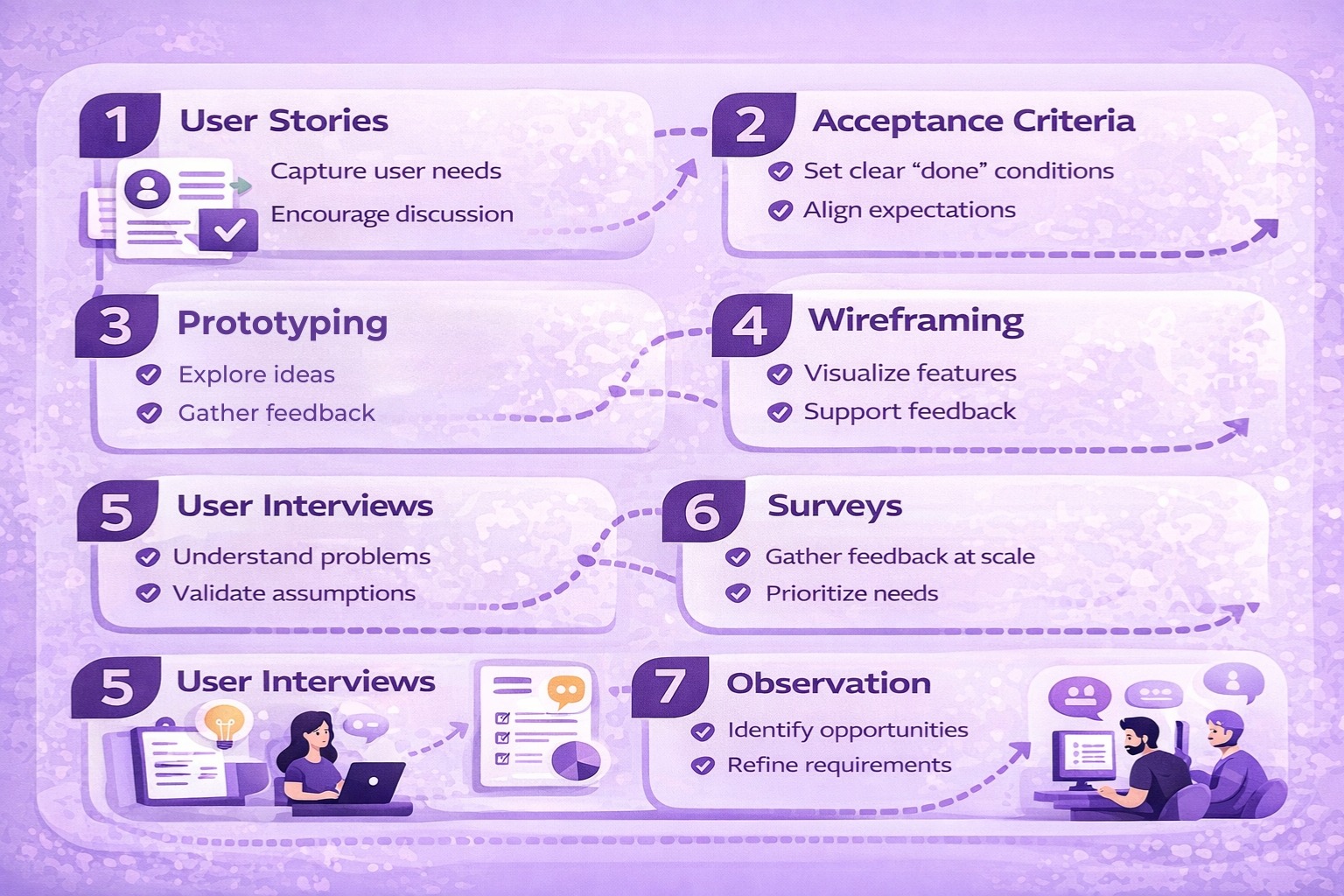
In Agile, requirements are shaped through learning, not assumptions. Teams gather input from users, stakeholders, and real product behavior, then refine that input into clear, usable requirements. The goal is not to capture everything at once, but to build shared understanding early and improve it as the product evolves.
Below are common tools and techniques Agile teams use to define requirements before and during development.
1. User stories
User stories describe what a user needs and why, keeping requirements grounded in real-world use rather than internal assumptions by anchoring work around real user needs and intent. They act as conversation starters rather than detailed specifications.
Used well, user stories help teams:
- Frame requirements around user value
- Encourage discussion instead of rigid interpretation
- Keep requirements clear and focused
2. Acceptance criteria
Acceptance criteria define the conditions a feature must meet to be considered complete. They provide clarity and help align expectations across product, development, and testing.
Teams use acceptance criteria to:
- Reduce ambiguity early
- Validate whether requirements have been met
- Ensure consistent understanding of “done.”
3. Prototyping
Prototypes offer a simple, tangible version of a feature or product concept. They help teams and stakeholders visualize requirements before a significant development effort begins.
Prototyping is useful for:
- Exploring ideas quickly
- Gathering early feedback
- Aligning expectations across teams
4. Wireframing
Wireframes provide a basic visual layout of screens or workflows. They focus on structure and interaction rather than design detail, making them effective for early requirement discussions.
Wire framing helps teams:
- Clarify user flows
- Identify missing or unclear requirements
- Support faster feedback cycles
5. User interviews
Direct conversations with users help teams understand real needs, pain points, and expectations. Interviews often reveal insights that written requirements alone cannot capture.
User interviews support:
- Better problem understanding
- Validation of assumptions
- More relevant feature definition
6. Surveys
Surveys allow teams to collect input from a wider audience efficiently. While less detailed than interviews, they are effective for identifying trends and prioritizing needs.
Surveys are commonly used to:
- Gather feedback at scale
- Validate demand for features
- Inform backlog decisions
7. Observation
Watching how users interact with a product or process can uncover issues users may not articulate directly. Observation helps teams spot friction, workarounds, and unmet needs.
This technique helps teams:
- Identify improvement opportunities
- Understand real usage patterns
- Refine requirements based on behavior
Adapting agile requirements for your industry
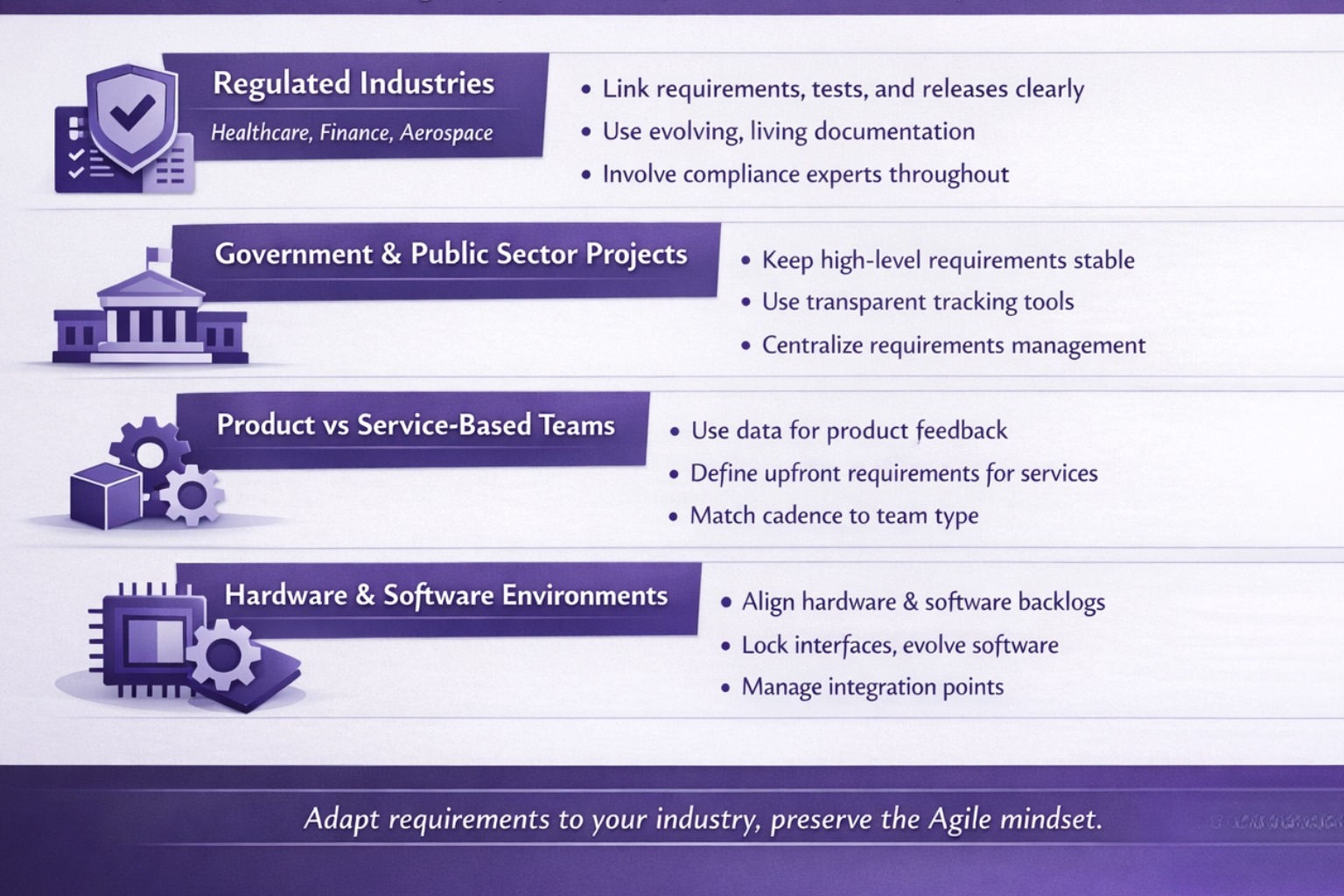
Agile is flexible by design, but requirements do not live in the same environment across industries.
Regulation, delivery models, and stakeholder expectations all shape how requirements are gathered, validated, and maintained, requiring industry-specific adaptation without losing the core Agile mindset.
Here is how Agile requirements shift across common industry contexts.
Regulated industries: healthcare, finance, aerospace
In regulated environments, requirements must balance adaptability with accountability. Teams cannot move fast at the expense of traceability or compliance.
What works best:
- Maintain clear links between requirements, tests, and releases
- Use living documentation that evolves with each change
- Involve compliance and domain experts throughout development, not just at review stages
Agile teams succeed here by building compliance checks directly into their workflow rather than treating them as a separate process.
Government and public sector projects
Public sector projects often operate within fixed scopes, formal approvals, and multiple vendors. Agile works best when requirements are structured at different levels.
Effective approaches include:
- Keeping high-level requirements stable while allowing flexibility at the story level
- Using transparent tools to make progress and changes visible
- Centralizing requirements to avoid version conflicts across contractors
Clear structure and visibility help Agile teams navigate complexity without slowing delivery.
Product vs service-based teams
Product teams and service teams manage requirements differently because their feedback loops differ.
In practice:
- Product teams rely on usage data and ongoing feedback to refine requirements continuously
- Service teams often define requirements more upfront to align with client expectations
- Cadence matters. Product teams evolve stories sprint by sprint, while service teams adjust based on client milestones
Agile works for both when the requirement depth matches the pace of change.
Hardware and software environments
When hardware and software are developed together, requirements move at different speeds. Hardware often needs more stability, while software remains flexible.
Teams manage this by:
- Separating hardware and software backlogs but aligning them through shared goals
- Locking down interfaces while allowing software stories to evolve
- Treating integration points as first-class requirements
Successful teams think beyond individual sprints and manage requirements at the system level.
Turn your entire agile requirement system into a source of clarity
Agile requirements do not have to feel like a moving target. When teams are intentional about how requirements are gathered, refined, and validated, change becomes easier to manage through a structured approach to change rather than something to fight against.
By applying the techniques and industry-aware practices covered in this guide, teams can keep requirements clear, aligned, and ready for delivery. Strong agile requirements help teams stay sprint-ready, maintain confidence, and adapt without losing control as priorities evolve.
_light%201.avif)